
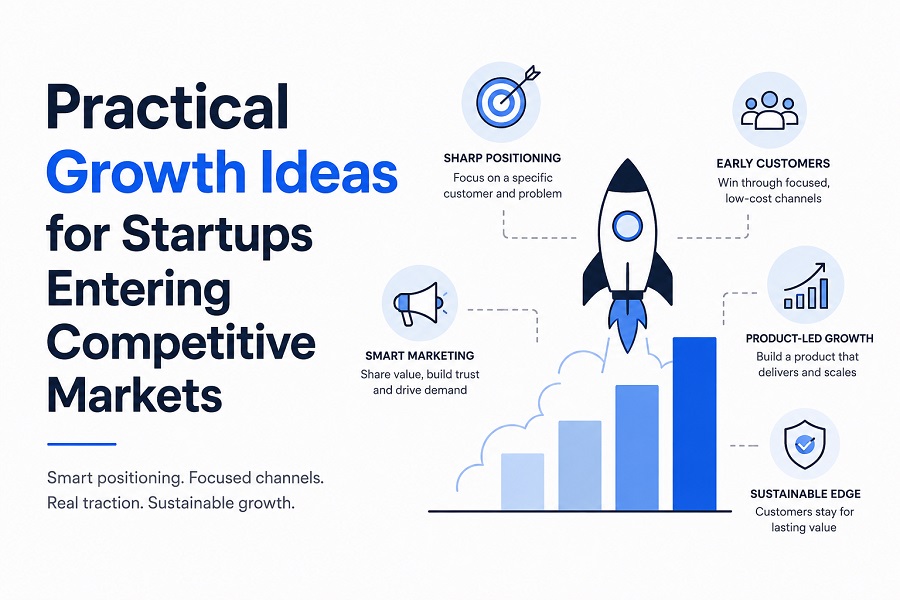
Finding a Sharp Market Position Before You Compete
A startup enters a competitive market with limited time, money, and trust. The team must choose a clear place to win before it tries to reach everyone. A sharp market position helps the startup explain who it serves, what problem it solves, and why the offer matters now.
The first step is simple research. The team should study customer demand, market size, pricing, customer pain, and the number of similar options. The U.S. Small Business Administration states that market research helps a business find customers and competitive analysis helps a business make its offer unique. This advice gives startups a practical starting point. A founder should list the top competitors, compare their promises, read their reviews, and speak with buyers who tried those products.
A startup should then choose a small customer group with a clear problem. A project management tool should not start by selling to every company. It can start with design agencies that lose time during client approvals. A finance app should not start by selling to all households. It can start with freelancers who need simple tax records. This focus gives the team a direct message and a faster sales path.
Airbnb gives a useful case. The founders did not start with a global travel plan. They solved a local lodging problem during a busy San Francisco conference. They used a simple site, photos, and three air mattresses. The first guests proved that people would pay for a more personal lodging option. This small test helped the team learn before it grew.
A focused position also protects the startup from direct price fights. Large companies can lower prices, buy ads, and copy features. A small team can win by serving a narrow group better. The startup can use the customer language, build the right feature set, and remove extra steps from the buying process. Buyers notice this fit because the product feels made for their exact job, even when the product stays simple.
Founders should write one positioning sentence before they spend on growth. The sentence should name the buyer, the problem, the outcome, and the reason to believe. For example, a startup can say, “We help small dental clinics reduce missed appointments with automatic patient reminders that staff can set up in one day.” This sentence gives sales, content, and product teams the same direction.
A weak position says, “We help businesses grow with better software.” A strong position says, “We help local gyms turn trial members into paid members with simple check-in messages.” The second sentence gives a clear buyer and a clear result. It also gives the team an easy way to find early customers.
Winning Early Customers Through Focused, Low-Cost Channels
A startup should use low-cost channels before it buys large ad campaigns. Early growth needs learning as much as sales. The team must see which buyers respond, which message works, and which offer creates action. A small budget forces clear choices.
The best early channels often sit close to customer intent. These channels include search content, founder-led sales, partner referrals, local communities, product directories, webinars, and niche newsletters. A startup should choose one or two channels and test them with care. Too many channels create noise. One focused channel creates learning.
Search content can work well in competitive markets if the team targets specific buyer questions. A startup should not chase broad terms first. It should answer narrow questions that signal a buyer need. For example, a founder who studies niche search phrases such as Kiralık bahis sistemleri (Rental betting systems) can learn how buyers compare platform costs, service models, and setup needs before they speak with a vendor. This type of research helps a team write useful pages that answer real questions in a clear way.
Founder-led sales also works because founders can learn directly from prospects. A founder should send short messages to a narrow list of buyers. Each message should show knowledge of the buyer’s problem. The goal should not be a hard sale at first. The goal should be a short call, a pilot, or feedback on the current solution.
Slack gives a strong example. Before Slack launched widely, the team asked friendly companies to try the product. First Round Review reported that Slack started with six to ten companies, learned from larger teams, and improved the product after each round. The preview release later gained 8,000 invite requests on the first day and 15,000 within two weeks. This case shows that a startup can use small groups to test a product, refine onboarding, and build momentum before a full launch.
Dropbox also shows the power of a low-cost growth loop. Dropbox gives extra storage to both the user who refers a friend and the friend who joins. The reward connects directly to the product value. This referral idea worked because users had a simple reason to share. They received more space, and their friends received value too. A startup should use this lesson with care. A referral program should reward behavior that supports product use, not random clicks.
Early customer channels should match the product type. A B2B tool can use founder calls, LinkedIn posts, and partner webinars. A local service can use Google Business Profile, local search pages, and neighborhood groups. A consumer app can use short videos, referral prompts, and creator partnerships. The team should track cost, time, conversion, customer quality, and repeat use.
A startup should also build proof into each channel. A sales email can include a short case result. A landing page can show a short quote. A webinar can show a live workflow. These details make the offer feel real. Customers in crowded markets need proof before they take a risk on a new company.
Building Trust and Differentiation Against Established Players
Customers often choose known brands because they reduce risk. A startup must lower that risk before it asks for money, data, or time. Trust grows when the company makes clear promises, shows proof, and keeps the first experience simple.
A startup can build trust with visible signals. These signals include customer stories, founder profiles, clear pricing, security notes, fast support, service guarantees, and plain product demos. The team should not hide important details behind vague claims. Buyers want to know what the product does, how long setup takes, what support they get, and what happens if the product fails.
Differentiation should come from a clear customer benefit. It should not come from a long feature list. A small company can say, “We help restaurant owners build a staff schedule in ten minutes.” This message is stronger than “We offer advanced workforce software.” The first message shows a clear result. The second message adds weight without clarity.
Airbnb used trust signals in a market that had high risk. Travelers needed to trust strangers. Hosts needed to trust guests. Strong photos, descriptions, reviews, and profiles helped the marketplace feel safer and more useful. The company also improved listing quality because better photos and clearer pages helped guests make a decision. The lesson applies to many startups. If the customer must take a risk, the product must answer trust questions before the sales call.
Slack also built trust by teaching teams how to use the product. The company did not assume that every buyer understood the category. It explained the product, gave admins useful material, and made team adoption easy. This matters for new startups because many competitive markets still contain confused buyers. Buyers may know they have pain, but they may not know how to compare options. Clear education can become a strong growth tool.
Startups should also choose a contrast point. The contrast point tells the buyer why the startup differs from big brands. The startup may be faster, simpler, more specific, easier to start, or stronger for one narrow use case. For example, a new customer support tool can say, “Built for Shopify stores that answer support from Instagram, email, and chat in one inbox.” This statement gives a buyer a reason to compare the startup with larger tools.
The company must support the claim with proof. If the startup says setup takes one day, it should show a setup checklist. If it says support responds fast, it should publish support hours or average response time. If it says it serves a niche, it should show niche use cases. Trust grows when the message, product, and service match.
A useful trust plan includes three parts. First, the startup should remove fear with clear pricing, plain terms, and safe trials. Second, it should show proof with real users, data, screenshots, and named examples where possible. Third, it should create a simple first win. The first win can be a saved hour, a completed task, a cleaner report, or a faster sale. That first win gives the customer a reason to stay.
Turning Early Traction Into Repeatable, Sustainable Growth
Early traction can mislead a startup. A launch spike, a viral post, or a small group of friendly users can feel like a growth system. It is not a system until the team can repeat it with clear steps and steady results. A startup must turn early wins into a process.
The first task is to define the growth signal. The signal should show real value, not surface interest. Email signups, page views, and social likes can help, but they do not prove that customers receive value. Better signals include trial activation, repeat use, paid conversion, referral rate, renewal rate, and time saved for the customer.
A startup should build a simple growth dashboard. The dashboard should track the source of each lead, the cost of each channel, the conversion rate, the time to first value, the number of active users, and the reason customers leave. The team should review these numbers every week. This habit helps the team move from guesses to decisions.
The next task is to document the playbook. If founder-led sales works, the team should write the target profile, message template, follow-up timing, demo flow, objection list, and close steps. If search content works, the team should write the topic selection method, page format, update schedule, and conversion goal. If referrals work, the team should define the reward, trigger point, share message, and fraud controls.
Dropbox gives a clear lesson here. A referral loop works best when the reward supports continued product use. Extra storage helped users get more value from Dropbox. This made the loop natural. A startup should ask, “What reward helps users succeed with our product?” The answer may be extra credits, added reports, free seats, partner access, training time, or a better plan for a limited period.
A startup should also balance speed with customer quality. Fast growth can attract users who do not fit the product. Poor-fit users increase support costs and create bad feedback. The team should score customers by fit, need, budget, and repeat use. A smaller group of high-fit customers can teach more than a large group of weak-fit users.
Customer retention deserves the same focus as customer acquisition. A startup in a competitive market cannot replace lost users forever. The team should improve onboarding, support, product speed, and customer education. It should ask new users what almost stopped them from buying. It should ask lost users why they left. These answers often show the next growth idea.
There are clear pros and cons to entering a competitive market. The main advantage is demand. Customers already spend money in the category, and the startup does not need to prove that the problem exists. Competitors also create buyer education. The main disadvantage is pressure. Ads cost more, buyers compare more options, and trust takes longer. A startup wins by choosing a narrow position, using low-cost channels, proving value fast, and repeating what works.
A practical growth plan can stay simple. The startup should pick one market segment, write one clear promise, test one or two channels, capture proof, and improve the first user experience. Then the team should measure the result and repeat the strongest step. Growth in a crowded market does not require a loud launch. It requires a clear buyer, a useful offer, honest proof, and steady action.
